

In-depth Course
year-long course for the serious yoga student
The next step in your yoga development
The In-Depth Course is a year-long program for students with a solid foundation in Iyengar yoga who wish to deepen their own practice. You will develop a deeper understanding of āsana and prāṇāyāma. By connecting themes from yoga philosophy and practical anatomy with practice, you will gain a richer understanding of yoga as a whole.
Four experienced, certified Iyengar yoga teachers guide the course. Drawing on their own experience and perspectives, they teach postures, breathing, philosophy, and practical anatomy.
Each course day has its own theme. You will receive reading material and guidance for home practice, allowing you to continue working on your own practice between course days.
Due to the variety of themes and teachers, you can take the In-Depth Course multiple times. It is also possible to attend individual course days, for example, for deepening, refreshing, or inspiration for your own practice or teaching.
Do you wish to learn to teach? In that case, the In-Depth Course aligns well with Mentor Program.
Who is the In-Depth Course for?
Do you:
- have at least a year of Iyengar yoga classes?
- desire to start or further develop a regular home practice?
- wish to study āsana and prāṇāyāma in greater depth?
- have an interest in yoga philosophy and practical anatomy?
- want to integrate yoga more into your daily life?
- need inspiration for your own practice or for teaching?
- enjoy practicing and learning together with like-minded people?
- have a curious and open attitude?
Then we look forward to meeting you at our In-Depth Course!
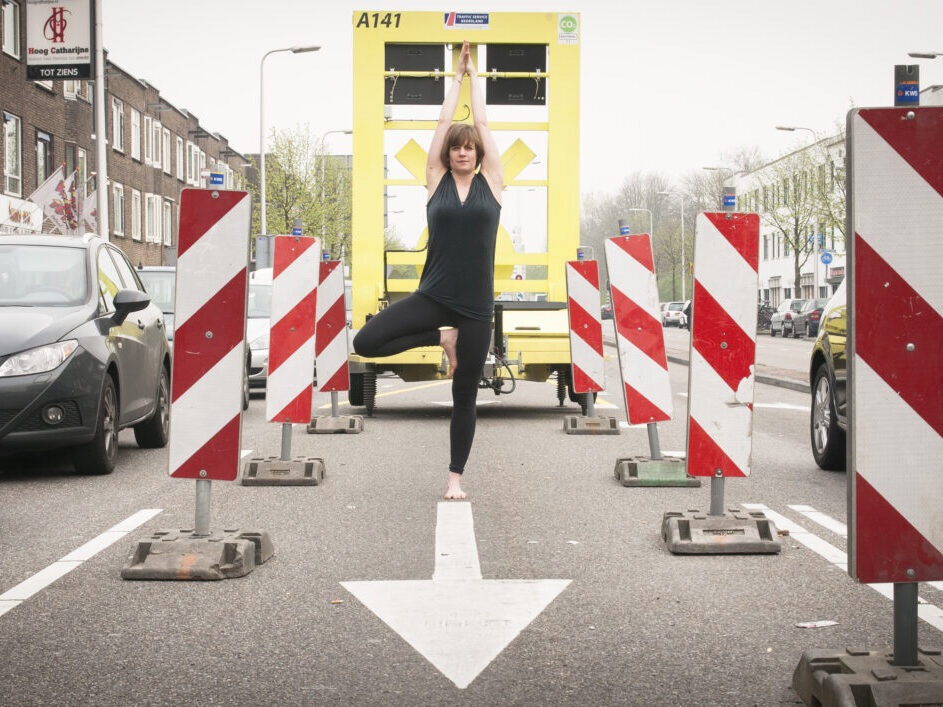
Photo credit: Chantal Aimee Ehrhardt
Practical information
The course days usually take place on a weekend (i.e. a consecutive Saturday and Sunday). This gives the teachers time to get to know the students present better and to explore a subject in more depth. Class times are from 10am – 4pm with a short lunch break in between. The first and last day of classes are ‘separate’ on a Sunday.
The course is given in our well-equipped studio, so you do not need to bring your own props. For lunch you can grab something nearby or bring your own lunch and eat it in the lobby. You can also make coffee and tea there.
Students who take the full course will be given priority for participation. If there is room available, participation on the basis of one weekend or individual days is possible.

Photo credit: Chantal Aimee Ehrhardt
2027-2027: 'Light on Yoga' in practice
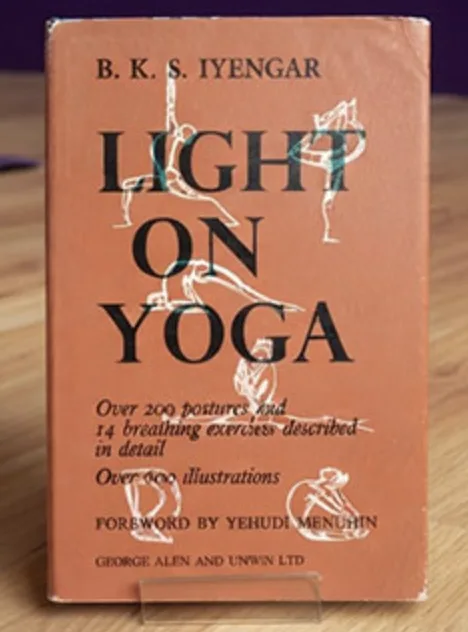
What happens if you start again at the base? In the back of Light on Yoga there is an exercise program designed by BKS Iyengar, in which he takes you step by step through the āsanas from the book.
This course year, Course I from Appendix I of Light on Yoga by B.K.S. Iyengar takes center stage. The original course lasts 30 weeks. During this edition of the In-depth course you will also practice the program at home for thirty weeks. During the course days we delve into the postures that are introduced in the different phases and connect them with themes from yoga philosophy and practical anatomy.
Repetition and regular return to the same āsanas provides depth. You get the time to really get to know and understand the postures. The course days and your own practice at home reinforce each other: in class you research and refine, and at home you put what you have learned into practice.
Through this methodical way of practicing, you develop not only strength, stability, and flexibility, but also an increasingly refined body awareness. The basis for further concentration and meditation. In this way, you develop a foundation that will benefit you throughout your life.
So make sure you have Light on Yoga in your possession. You can scroll further down for the rest of the book list.
Dates and subjects 2026-2027
** Dates subject to change.
4 oktober 2026 – Hiske | Book day 1
Beginning with the Basics · Sādhana & Abhyāsa
The course begins with the basic āsanas from the first weeks of Course I. How does B.K.S. Iyengar build the practice step by step in Light on Yoga?
We also explore the meaning of sādhana and abhyāsa, and the difference between the two. What does regular and dedicated practice ask of us? What attitude towards practice helps us move forward, and how does our practice change over time?
Read: Yoga Sūtra’s I.13–14
Practice: week 1-4
7-8 november 2026 – Kristien | Book dag 2 | Book dag 3
Non-Violence and Truthfulness · Ahiṃsā & Satya
Ahiṃsā and satya, non-violence and truthfulness, are familiar concepts from yogic philosophy. What do they mean in practice? As āsana and prāṇāyāma become more refined, these qualities can develop as well: not as goals in themselves, but as something that can emerge from the practice.
As we work through the following weeks of Course I, new āsanas are introduced, while returning to familiar poses creates space for refinement and deeper understanding.
Read: Yoga Sūtras II.30–31, II.35–36
Practice: week 5-8
28-29 november 2026 – Kerry | Book day 4 | Book day 5
Stability and Ease · Sthira–Sukha
The āsanas in Course I gradually become more extensive, requiring increasing attention to the quality of practice. Sthira and sukha, stability and ease, take on an increasingly precise meaning.
A stable and friendly relationship with the mind is essential for finding stability and ease in āsana. The foundations of dhāraṇā, concentration, are introduced, along with a simple seated practice for home. The Yoga Sūtras describe different aspects of the nature and movements of the mind, offering a framework for understanding our own experience on the mat.
Read: Yoga Sūtras I.2–I.4, II.46
Practice: week 9-13
16-17 januari 2027 – Kristien | Book day 6 | Book day 7
Working with Pain and Injury · Heyam duḥkham anāgatam
At this stage of Course I, the connections between different āsanas become clearer. The longer sequences also call for an intelligent approach to effort, limitations and recovery.
Heyam duḥkham anāgatam points to the possibility of preventing future suffering. What does this principle mean for daily practice? Pain, difficulties and injuries provide an opportunity to look more closely at what the body needs. Practical questions, troubleshooting and space for questions arising from your own practice are central to this weekend.
Read: Yoga Sūtra II.16
Practice: week 14-15
13-14 februari 2027 – Hiske | Book day 8 | Book day 9
Yoga in Action · Kriyā Yoga
As āsanas are practised repeatedly and in different combinations, they take on increasing meaning within the practice as a whole. Prāṇāyāma also becomes part of the practice.
Tapas, svādhyāya and īśvara-praṇidhāna together form Kriyā Yoga. Regular practice can make patterns visible while also setting something in motion. What happens when practice is not only an exercise, but also a means of inquiry and transformation?
Read: Yoga Sūtra II.1
Practice: week 16-18
20-21 maart 2027 – Nanda | Book day 10 | Book day 11
Patterns and conditioning · Saṃskāra & Vāsanā
The Course I sequences become increasingly rich, and familiar āsanas return in a broader context. This repetition brings subtle differences to light: in the body, in the breath and in the way the mind responds.
Why are we naturally drawn towards what feels pleasant and repelled by what feels unpleasant? Saṃskāras and vāsanās refer to patterns and conditioning that influence our thoughts and actions. Preferences, resistance and uncertainty also become visible during āsana and prāṇāyāma. Practice offers an opportunity to recognise these patterns without automatically acting on them.
Reading: Yoga Sūtras II.10–15
Read: Yoga Sūtra’s II.10-15
Practice: week 19-21
17-18 april 2027 – Kerry | Book day 12 | Book day 13
Less (Effirt) is more (Ease) · Prayatna Śaithilya (YS II.47)
As we go further into Course I, more and more elements of the practice come together. Repetition makes it possible to focus less on performing individual poses and more on the quality and direction of effort.
Prayatna śaithilya, the softening of effort, is the starting point. The philosophy of the kośas, the five layers of our being, offers a way of directing our attention increasingly inward. Sensitivity and discernment can help us use effort more intelligently, until effort and ease no longer seem to be opposites.
Read: Yoga Sūtra II.47
Practice: week 22-25
15-16 mei 2027 – Nanda | Book day 14 | Book day 15
Turning inward · Pratyāhāra
In the final weeks of Course I, the different elements of the practice increasingly come together. A longer and more independent practice takes shape, with more room for personal choices.
Pratyāhāra, the turning inward of the senses, marks the transition towards the more inward aspects of yoga. Breath, attention and stillness play an important role. What changes when our attention becomes less determined by external stimuli?
Read: Yoga Sūtra’s II.54–55
Practice: 26-30
13 juni 2027 – Hiske | Book day 16
Discernment en clarity · Viveka
The final course day brings the year as a whole into focus: thirty weeks of Course I, from the first basic āsanas to a more independent and integrated practice. What has the systematic progression revealed? Which poses have become familiar, and where is there still room for exploration?
Viveka, discernment, means seeing clearly what is actually happening. Through regular practice, our ability to distinguish gradually develops: what works, what does not, what helps and what gets in the way. This clarity supports an independent practice that can continue beyond the course year.
Read: Yoga Sūtra’s II.26–29
Prices
Full Course
€990 for the full year program consisting of 16 days.
It is also possible to pay in 4 installments of €250. Pay no later than October 1, December 1, February 1, and April 1.
By purchasing 4 installments, you commit for the entire year; it is not possible to purchase only 1 installment.
Partial participation
- €160 for one weekend.
- €90 for one day.
The In-Depth Course is structured as an ongoing year-long course. Attending individual days is possible if there is sufficient space. For example, if you have previously taken the In-Depth Course or wish to delve deeper into a specific theme.
What do you need
Book list
- Light on Yoga (Yoga Dipika in het Nederlands) – BKS Iyengar
- Light on Prānayāma – BKS Iyengar
- Light on Life (Yoga als Levenskunst) – BKS Iyengar
- Light on the Yoga Sūtras of Patañjali – BKS Iyengar
- Yoga in Action (Yoga in Actie) deel 1 en 2 – Geeta Iyengar
Verder lezen (niet verplicht, wel warm aanbevolen)
- The Tree of Yoga – BKS Iyengar
- Yoga, a Gem for Women – Geeta S. Iyengar
- Bhagavad Gita (for instance by Stephen Mitchell or Eknath Easwaran)
- The Gift of Consciousness – Gitte Bechsgaard
- Yoga Asana Anatomy – Hermann Traitteur
Props
The studio is fully equipped with all mats and props, so you don’t need anything for the course weekends. We do ask you to practice at home on your own, so you might need some equipment there. You don’t necessarily have to purchase this in advance; you can also assess what you need along the way and add what you are missing.
Vragenlijst
If you participate in this course, we would like to know a little more about you. Once you have registered, please complete this questionnaire. Then we can get to know you a little bit in advance. The answers are only visible to the teachers and will, of course, be treated confidentially. Please fill out the questionnaire even if you are signing up for only one day or a weekend.
Homework
There is homework for every session, including practicing the sequences. The homework that is known in advance is published above in the lesson schedule. Additional (reading/listening/writing) assignments may follow during the year; these will be sent by email.
Register – how it works
Enroll via Momoyoga. Here’s how it works:
- Create an account with Momoyoga via www.momoyoga.com/iyoga-utrecht.
- Purchase the Advanced Course via the ‘Pricing’ page.
- You can pay directly for the entire year.
- If you wish to participate for the entire year but want to pay in installments, select the payment option: ‘Verdiepingscursus | 4 termijnen’. Paying in installments means committing to the full year. Therefore, it is not an option to take 4 lessons and pay for 1 installment. After each ‘block’ of 4 lessons, you can purchase the next ‘block’ and register for the next 4 lessons.
- Als je niet alle lessen wilt volgen, kun je kiezen om per dag of per weekeind te betalen.
- Betaal je liever zelf per bankoverschrijving, kies dan in het boekings-/betaalproces ‘bankoverschrijving’. Je kunt niet meer met pin betalen op de studio.
Let op: nadat je betaald hebt, kun je je inschrijven voor de cursus. Ook als je de hele cursus gekocht hebt, moet je je voor iedere dag apart inschrijven! Om dat makkelijker te maken, staan de links naar de afzonderlijke dagen in het rooster hierboven.
Four experienced teachers
Hiske van der Meulen
Nanda Peek
Kristien van Reusel
Kerry Reinking